
The luminous efficiency and electrical characteristics of LED components are closely related to their epitaxial structure and material composition. Especially in blue LEDs, variations in the distribution and concentration of elements in Multi-Quantum Wells (MQW) and superlattice structures directly affect luminous efficiency, wavelength characteristics, and component reliability. Therefore, understanding the material composition and depth distribution of LED epitaxial layers through high-resolution material analysis techniques is of great significance for process development and quality control.
MA-tek utilizes material analysis techniques such as Transmission Electron Microscopy (TEM), Energy Dispersive X-ray Spectroscopy (EDX), and Secondary Ion Mass Spectrometry (SIMS) to accurately analyze the element distribution and depth concentration variations in the LED epitaxial structure, assisting customers in evaluating material quality and optimizing process conditions.
TEM / EDX element distribution analysis
Using Transmission Electron Microscopy (TEM) combined with Energy Dispersive X-ray Spectroscopy (EDX), elemental distribution analysis of LED epitaxial layers can be performed at the nanoscale. Through EDX Line Profile technology, the concentration variations of elements such as In, Al, Ga, and N in the crystal structure can be measured, and the periodic distribution of Multi-Quantum Wells (MQW) and superlattice structures can be observed.
This type of analytical technology can effectively identify material interfaces, compositional changes, and crystal defects, and can achieve approximately in superlattice structures.0.2 at% element identification limitprovides important basis for the research of LED material quality and epitaxial structure.
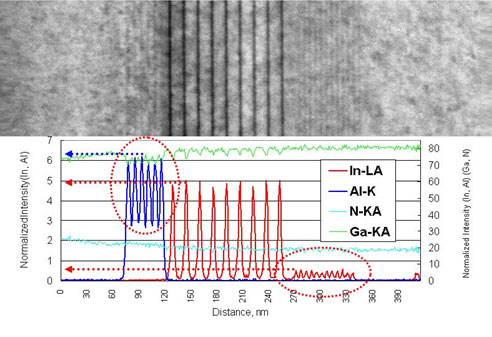
TEM / EDX Line Profile analysis of element distribution in blue LED Multi-Quantum Wells (MQW) and superlattice structures.
SIMS depth profile analysis
Secondary Ion Mass Spectrometry (SIMS) is a highly sensitive material analysis technique that measures the concentration distribution of different elements in a sample as a function of depth. Through SIMS depth profiling analysis, the doping distribution of various elements in the LED epitaxial layer and the material structure can be fully resolved, and the uniformity and quality of the epitaxial process can be evaluated.
SIMS technology has extremely high detection sensitivity and depth resolution capabilities, effectively identifying changes in material interfaces and doping concentrations, making it an important tool for LED material analysis and epitaxy research.
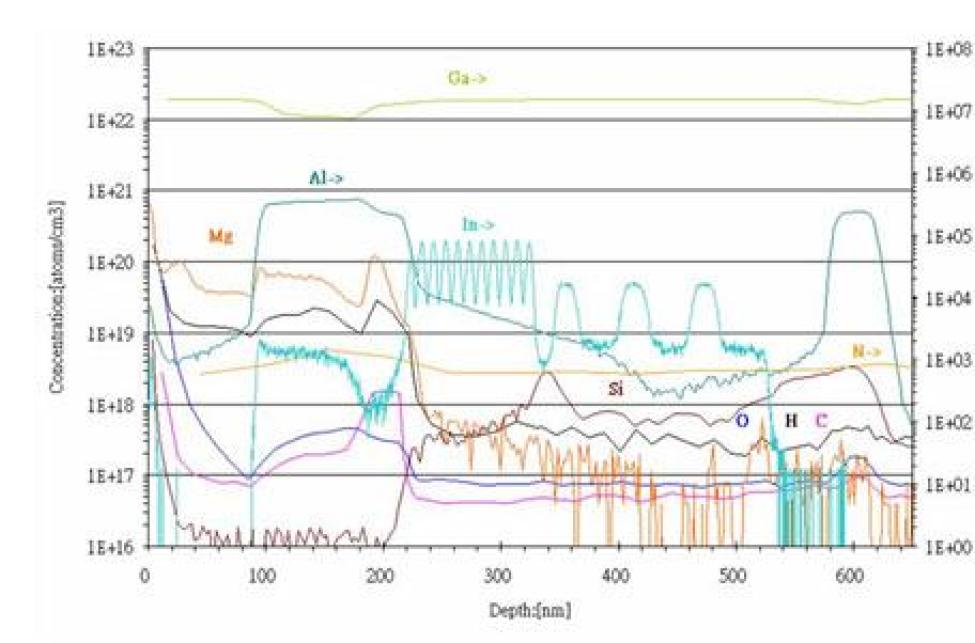
SIMS depth profile analysis shows the concentration variation of different elements with depth in the LED epitaxial layer.