
Zeta Potential Analyzer
Nanoparticles or colloidal particles in solution usually acquire a charge due to the adsorption of surface functional groups or ions, forming a layer of ions around the particles.Electric Double LayerThe electric double layer can be divided into the one close to the particle surface.Stern Layerwith the outsideDiffuse Layer。
Within the diffuse layer there exists a hypothetical interface known as the Slipping PlaneThe position represents the boundary of relative motion between the particles in the solution and the surrounding liquid, and the potential on this plane is defined asZeta PotentialThe ions located inside the sliding plane move along with the particles, so the Zeta potential can reflect the particles in the solution.Actual surface electrical properties and dispersion behavior。
Zeta potential is influenced by various factors, including the particles'Surface chemical properties, solution pH value, types and concentrations of electrolytesTherefore, it is often used to evaluate colloidal systems or nanomaterials.Important indicators of dispersion stabilityGenerally speaking, the greater the absolute value of the Zeta potential, the stronger the electrostatic repulsive force between particles, and the higher the dispersion and stability of the system.
During the measurement process, the Zeta potential analyzer will apply to the sample.external electric fieldto generate charged particles in solutionElectrophoresis,the instrument usesLaser Doppler Velocimetry, LDVMeasure the particle's movement speed and calculate itsElectrophoretic Mobility,Finally, the electrophoretic mobility is converted using Henry's Equation.Zeta potential value。
| Zeta potential (mV) | dispersion stability |
|---|---|
| 0 ~ ±10 | Very unstable, prone to aggregation |
| ±10 ~ ±30 | lower stability |
| ±30 ~ ±60 | Dispersion stability |
| > ±60 | highly stable |
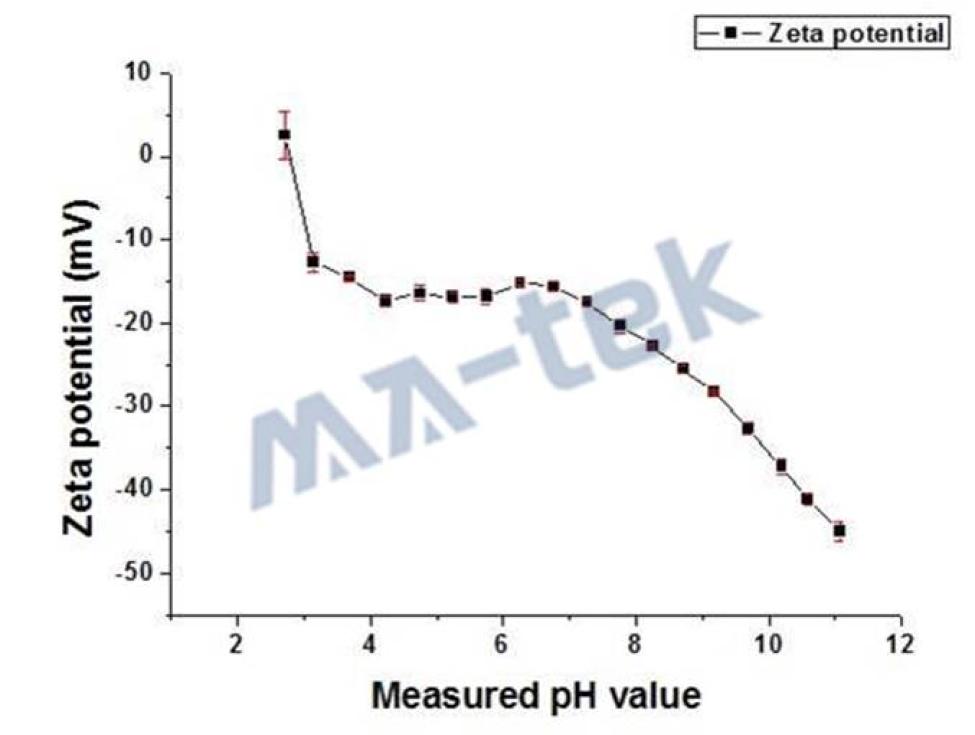
Analysis results
Under low pH (acidic) conditionsAt low pH, Zeta potential is near 0 mV, indicating weak electrostatic repulsion and potential aggregation.
As the pH value increasesZeta potential gradually becomes negative, indicating that the particle surface carries a negative charge.
Under high pH (alkaline) conditionsAt high pH (alkaline), the absolute value of Zeta potential increases (around -30 mV), enhancing repulsion and improving dispersion stability.
This result showsSolution pH affects particle surface charge and dispersion stability.。
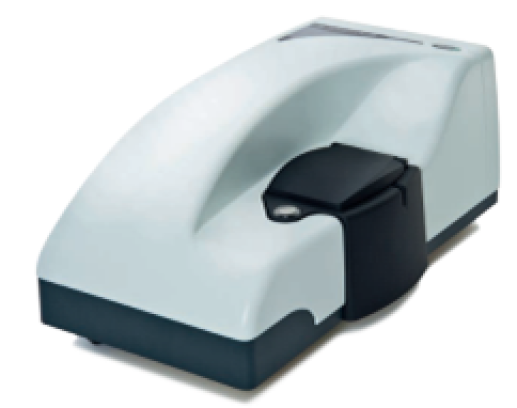
Malvern Nano-ZS
Malvern Nano-ZS is a system that combinesDynamic Light Scattering (DLS) and Zeta potential analysishigh-precision particle analyzer, which can be used to measure particles from nanometers to micrometers.size distribution, dispersion state, and surface charge。
This instrument uses the principle of laser light scattering to measure the particles in the solution.Brownian motionThe particle's calculation through the variation of scattered light intensity.Hydrodynamic DiameterAt the same time, it can be accessed throughElectrophoretic Light Scattering (ELS)The technology measures the movement speed of particles in an electric field, and then calculates theirZeta potentialto evaluate the dispersion stability of particles.
Nano-ZS hasHigh sensitivity and high resolutionIt can quickly analyze nanomaterials, colloidal systems, biomolecules, and various types of dispersions, making it a commonly used analytical instrument in material research, nanotechnology, biomedical, and chemical industries.