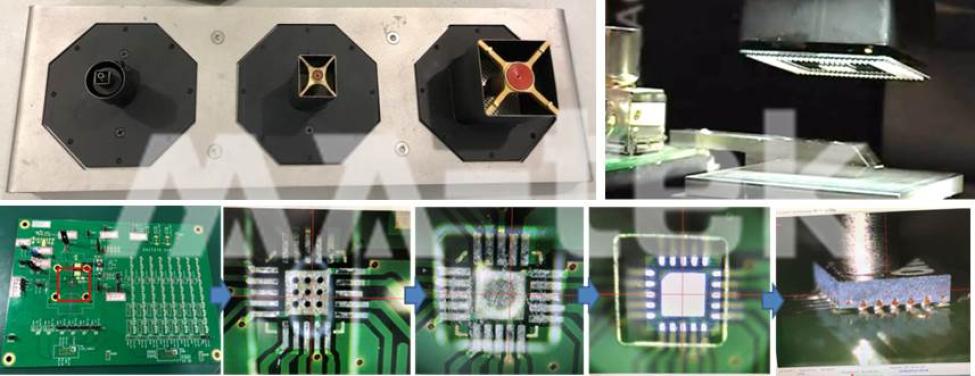
Repair Workstation
In the process of semiconductor packaging and electronic product development, when a component malfunctions, needs to be replaced, or requires further analysis,Rework technologyhas become an indispensable key process. Through precision rework equipment, operations such as IC disassembly, cleaning, ball re-implantation, and reflow can be completed without damaging the substrate and surrounding components. MA-tek introduces high precisionRework Stationproviding a complete and controllable rework process, supporting advanced packaging, failure analysis (FA), reliability verification (RA), and research and development testing requirements, assisting customers in quickly completing sample reconstruction and problem analysis.
The core of the repair process lies in the precise control of temperature, time, and alignment. After the component is disassembled using thermal energy, it is necessary to completely remove the residual solder from the pad and re-establish a stable solder ball structure. Finally, through precise alignment and reflow processes, the component forms a reliable electrical and mechanical connection with the substrate again. From disassembly, pad cleaning, ball placement to reflow, each stage requires precise control to ensure packaging quality and electrical stability. The process not only demands stable equipment performance but also relies on engineering experience to adjust for different materials and packaging structures to effectively avoid issues such as pad damage, component displacement, or excessive diffusion of the heat-affected zone.
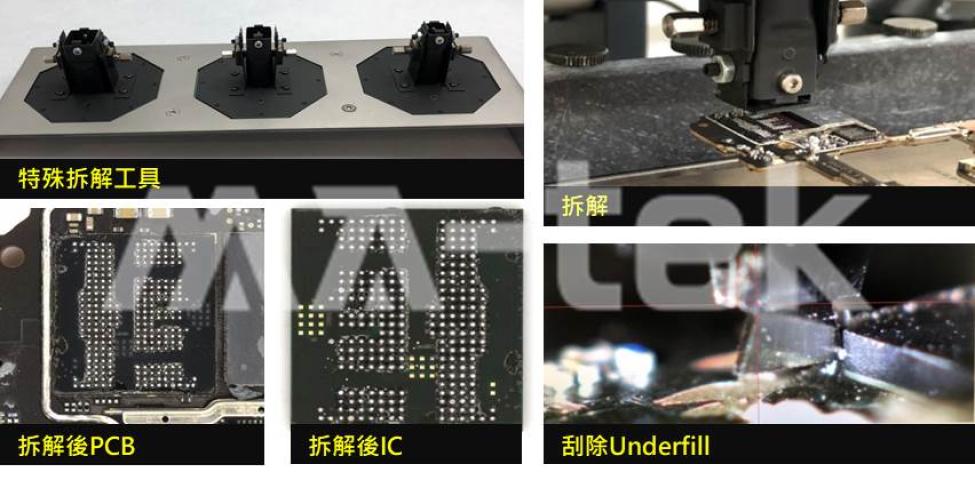
IC repair process flow diagram
-
IC debonding:Safely remove components from the PCB using hot air or infrared heating.
-
Pad Cleaning:Remove residual solder to ensure the integrity of the solder pad.
-
Reballing:Re-manufacturing of solder ball structure.
-
Precision Alignment:Using optical systems for high-precision positioning.
-
Reflow:Complete the rejoining of components.
The application of the Rework Station covers various packaging types and electronic components, including BGA, QFN, QFP, PoP, and various high-density packages. It can also be applied to connectors, RF modules, sub-board structures, and samples with underfill or protective coatings. In practical applications, this technology is often used for failed component replacement, electrical verification reconstruction, packaging defect analysis, and R&D sample preparation. By integrating with analytical techniques such as scanning electron microscopy (SEM), X-ray, ultrasonic scanning (SAT), and FIB, it can significantly enhance problem location efficiency and analysis depth.
In the high complexity environment of semiconductor packaging and electronic product development, Rework is not just a means of repair, but also an important tool for reconstructing samples and validating hypotheses. MA-tek, through complete equipment setup and cross-technology integration capabilities, can assist customers in completing sample reconstruction and problem analysis in the shortest time possible. When a sample "cannot move," Rework allows it to speak again, and MA-tek's value lies in making this process fast and accurate.
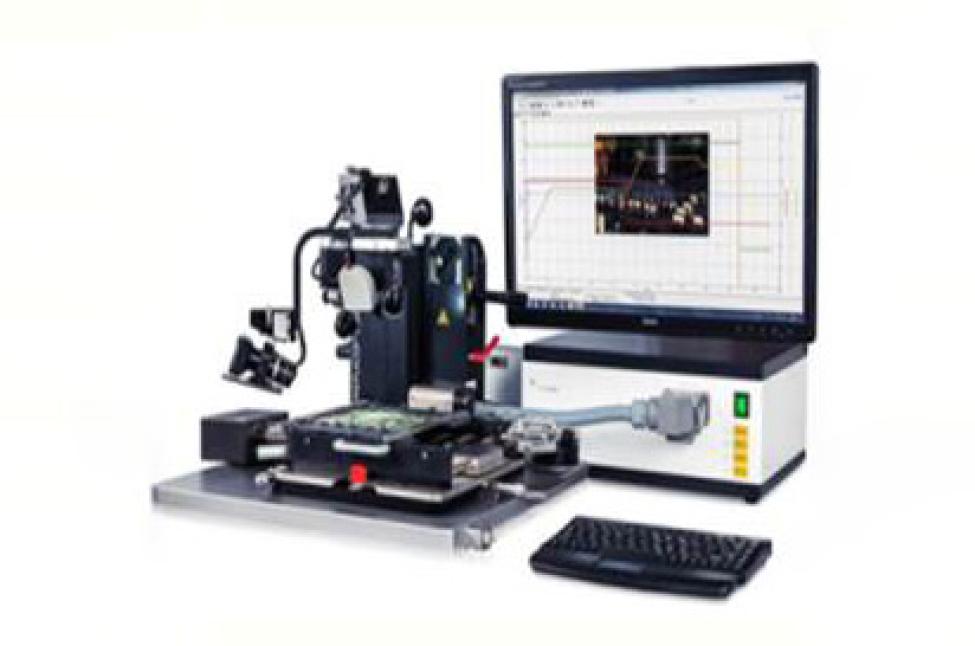
High-precision rework equipment integrates desoldering, ball placement, and reflow functions, allowing for stable and controllable process operations on various packaging components.
Rework Station integrates processes such as desoldering, cleaning, ball placement, and reflow on a single platform, allowing for precise control over different packaging types. Whether it is small passive components or advanced packages like WLCSP, BGA, PoP, and InFO, they can all be processed through a stable temperature control and alignment system. The Rework Station can complete the following processes on the same platform:
-
IC Debonding
-
Solder removal
-
Reballing
-
Component Reflow
The system supports everything from small passive components to large advanced packages, including:
-
WLCSP
-
BGA / µBGA
-
PoP (Package on Package)
-
InFO (Fan-Out Packaging)
The core advantage of MA-tek's Rework Station lies in the combination of high-precision equipment and rich process experience, making the rework process not only fast but also highly stable. Through an accurate alignment system and controllable heating curves, it effectively reduces the risk of substrate damage and pad delamination while improving the rework success rate. Furthermore, rework technology is not a single process but is closely integrated with material analysis and failure analysis. After completing the rework, MA-tek can immediately connect to the subsequent analysis process, providing a complete one-stop solution from structural observation to root cause determination.