

Chemical Mass SpectrometryMSis a highly sensitive analytical technique that can provide qualitative or quantitative detection information of elements or organic compounds according to analytical needs, widely applied inMaterial analysis, semiconductor analysis, wafer surface element and organic contamination detection, substance composition analysis, environmental monitoring, additive identification, biomedical research, gas release analysis, residue detection, food testing and chemical research. and other fields.
Mass spectrometry can be used to identify unknown compounds, analyze molecular structures, determine molecular weights, and conduct trace element and organic component analysis. Mass spectra are similar to spectra, but they display the signal intensity of different mass-to-charge ratio ions in the sample. By analyzing ion signals and fragment structures, one can infer the composition, isotope ratios, and molecular structures of compounds. MA-tek provides various mass spectrometry analysis services that can be applied toInorganic element analysis, organic matter analysis, and trace pollutant detection:
-
ICP-MS (Inductively Coupled Plasma Mass Spectrometry): provides trace element detection and analysis of samples, with excellent sensitivity and detection limits, widely used in various fields such as materials, soil, environmental water quality, food and drug testing, and biomedical element analysis.
-
GC-MS (Gas Chromatography–Mass Spectrometry): After database comparison, it can provide qualitative information, mainly for the detection of weak/non-polar organic compounds; when used with a thermal desorption device, it can perform outgassing component analysis.
-
LC-MS (Liquid Chromatography–Mass Spectrometry): It can screen polar organic compounds and provide quantitative analysis information when standard samples are available. It can also be applied to the detection of drug residues in water-soluble organic compounds.
The instrument used to measure mass spectrometry is called a mass spectrometer, which consists of three main parts: the ion source, the mass analyzer, and the detector. The basic principle of mass spectrometry analysis is to ionize the components in the sample in the ion source, generating positively charged ions with different mass-to-charge ratios. After being acted upon by an accelerating electric field, an ion beam is formed and enters the mass analyzer.
In the mass analyzer, different ions with varying mass-to-charge ratios are separated in space or time using electric or magnetic fields, or by filtering, and are focused onto the detector to obtain a mass spectrum, thereby acquiring spectra related to mass and concentration (or partial pressure). There are many types of mass spectrometers, which can be broadly categorized from an application perspective into the following categories:
- Organic mass spectrometers, such as gas chromatography-mass spectrometry (GC-MS) and liquid chromatography-mass spectrometry (LC-MS), etc.
- Inorganic mass spectrometers, such as Inductively Coupled Plasma Mass Spectrometry (ICP-MS) and Secondary Ion Mass Spectrometry (SIMS), etc.
- Other types of mass spectrometers, such as electrospray ionization mass spectrometry and matrix-assisted laser desorption/ionization mass spectrometry, etc.
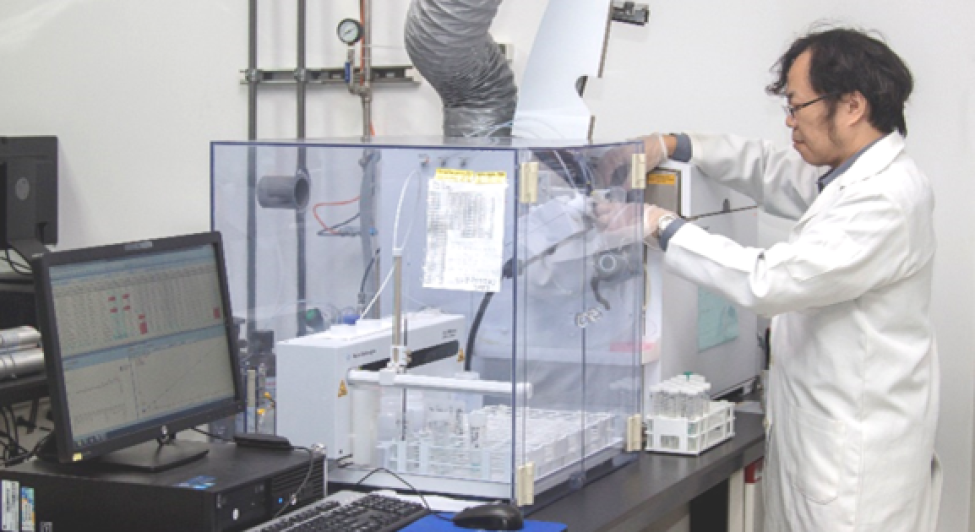
Analysis Applications
Common analysis items include trace element contamination on wafer surfaces, material composition and component testing, additive measurement, gas release testing, molecular weight determination of organic molecules, and so on.