
DLS Dynamic Light Scattering Particle Size Analyzer
Dynamic Light Scattering (DLS) is used forAnalysis of particle sizes from nano to micro scaleThe technology is based on the principle of using laser light to illuminate a solution or suspension containing the particles to be measured, causing the particles to generate scattered light signals. Due to the influence of Brownian motion, the particles in the solution will continue to move randomly, resulting in slight changes in the intensity of the scattered light over time. The instrument records these changes in scattered light signals through a detector and analyzes the temporal correlation of the scattered light intensity using the autocorrelation function.
The correlation function can be used to calculate the particles'diffusion coefficientThen, according to the Stokes–Einstein equation, calculate the particles'hydrated diameterthe effective particle size of particles in solution. DLS can not only provide the average particle size but also analyzeParticle size distributionand can assess whether particles are present.aggregation or agglomeration phenomenon。
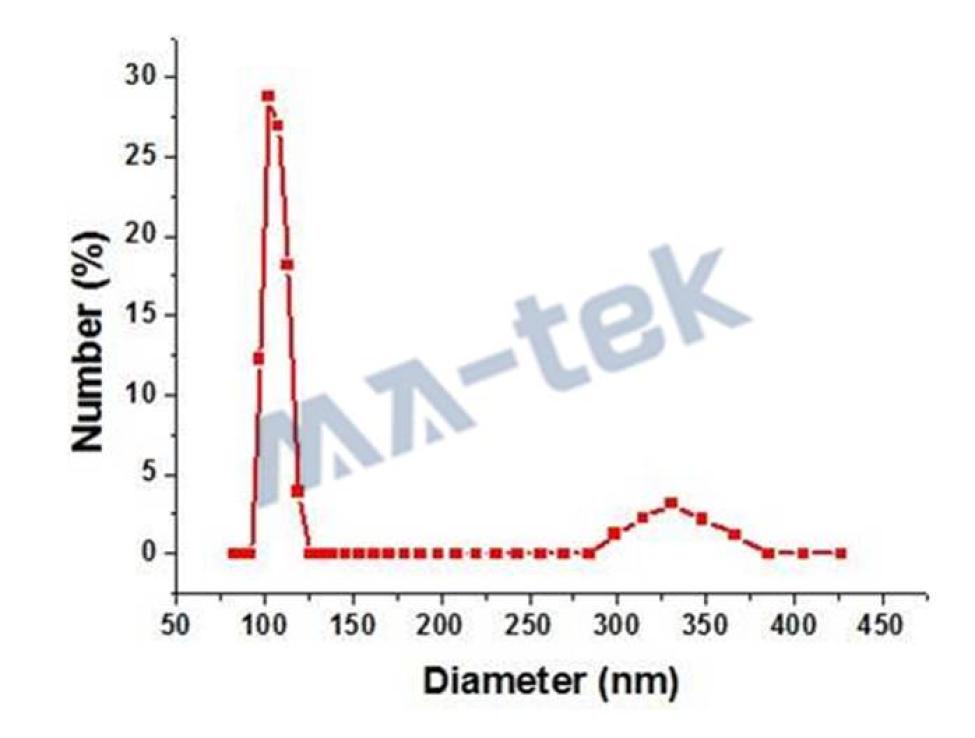
This figure is created usingDynamic Light Scattering Particle Size Analyzer (DLS)Measurement of Nano CaCO₃ in aqueous solutionParticle size distribution resultsThe horizontal axis represents the particles'Diameter, nmThe vertical axis represents the particle size in the sample.Number, %。It can be observed from the figure:
Main particle size distribution area
At approximately 100–120 nmA significant primary distribution peak appears nearby, indicating that most of the nano calcium carbonate particles in the sample are concentrated in this size range, showing that the main particle size in the solution is approximately~110 nm。
Particle aggregation phenomenon
At 300–350 nmA smaller distribution peak can be observed in the region, indicating that some nano calcium carbonate particles may occur in the aqueous solution.aggregation/agglomerationforming larger particle aggregates.
Dispersion State Assessment
The overall particle size distribution showsbimodal distributionrepresents the simultaneous existence in the system:
-
single nanoparticles (~100 nm)
-
Larger particles formed by aggregation (approximately 300 nm)
This result shows that the sample is in an aqueous solution.Dispersion is acceptable, but some aggregation of particles still exists.It may be related to the surface charge of the particles, solution pH, ionic strength, or dispersant conditions.
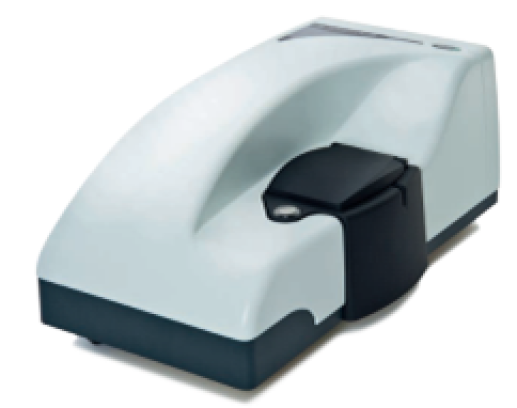
Malvern Nano-ZS
Malvern Nano-ZS is a system that combinesDynamic Light Scattering (DLS) and Zeta potential analysishigh-precision particle analyzer, which can be used to measure particles in the nano to micron scale.particle size distribution, dispersion state, and surface charge。
This instrument uses the principle of laser light scattering to measure particles in solution.Brownian motionthe particle's calculation through the change in scattering light intensityHydrodynamic Diameter; at the same time can be throughElectrophoretic Light Scattering (ELS)The technology measures the movement speed of particles in an electric field, and then calculates theirZeta potentialto evaluate the dispersion stability of particles.
Nano-ZS hasHigh sensitivity and high resolutionIt can quickly analyze nanomaterials, colloidal systems, biomolecules, and various dispersion systems, making it a commonly used analytical device in materials research, nanotechnology, biomedical, and chemical industries.