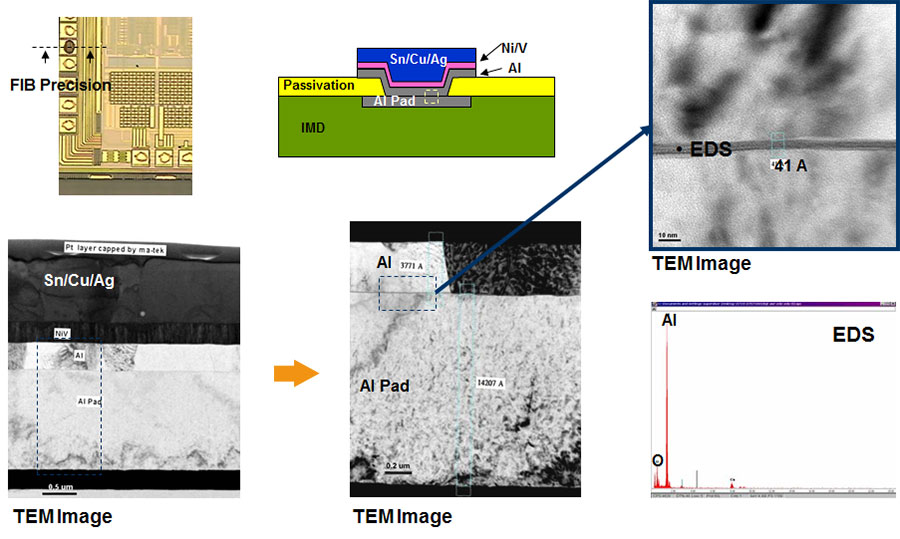
Reliability Analysis
The packaging must withstand temperature and mechanical stress tests in the actual operating environment. Through reliability analysis, the stability of the packaging under long-term operating conditions can be assessed, thereby reducing potential failure risks.
Case of bump failure after reliability testing
This case analyzes the bump failure phenomenon discovered in the product after reliability testing. By using FIB cutting combined with multi-scale microscopy techniques, the structural changes at the failure location are observed step by step.
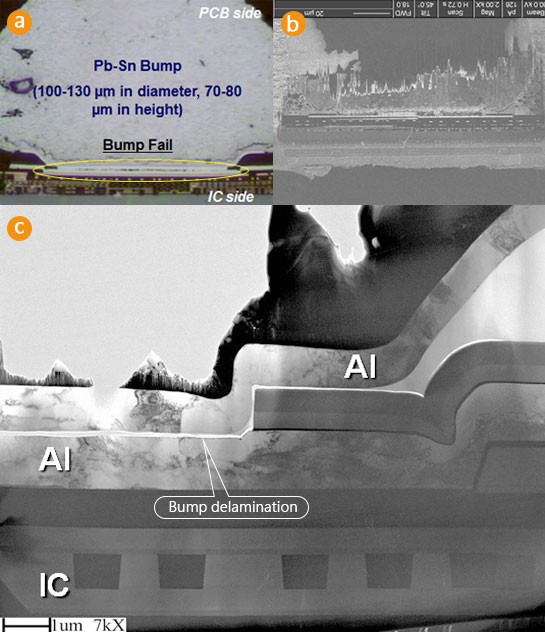
(a) Optical microscope (OM) images after FIB cutting, used to confirm the location of the failure area.
(b) FIB cross-sectional analysis, observing the internal structure and interface state of the bump.
(c) Transmission Electron Microscope (TEM) images further analyze the material and defect characteristics at the microscopic level.
Abnormal high resistance issue of bumps
The analysis results show that the bump structure experiences interface degradation under reliability stress, leading to obstruction of the conduction path and resulting in abnormal resistance increase. If such issues are not detected early, they may affect the long-term reliability and production stability of the product. Through precise cross-sectional analysis and high-resolution image comparison, it can effectively assist customers in clarifying the failure mechanism, serving as an important basis for subsequent process optimization and design improvement.