

Reliability Testing
What is reliability testing (Reliability Testing)?
Reliability testing refers to the expected number of product failures during the lifespan of a product after it is sold, and it can also estimate the proportion of return products (Return Material Authorization, RMA) during the warranty period through reliability assessment.
In the product research and development design phase, designers make every effort to convert product reliability requirements into design requirements and parameters. The U.S. Department of Defense's Electronic Equipment Reliability Advisory Group defined reliability in 1957 as follows: "Reliability is the probability (success probability) that a product will complete its mission under specified performance or functional conditions within a given time period and under specific usage (environmental) conditions, or the probability of failure occurring."
bathtub curveBathtub Curve
The bathtub curve is the most common model in reliability testing, used to describe the failure rate of a product throughout its entire life cycle (from deployment to disposal). It is named for its trend graph shape resembling a bathtub and is also known as the standard failure rate curve.。This model is particularly suitable for explaining the failure behavior of electronic components, clearly reflecting the reliability characteristics of the product at different stages.
The typical bathtub curve is shown in the figure, and the failure rate of a product or system can be roughly divided into three periods over time:
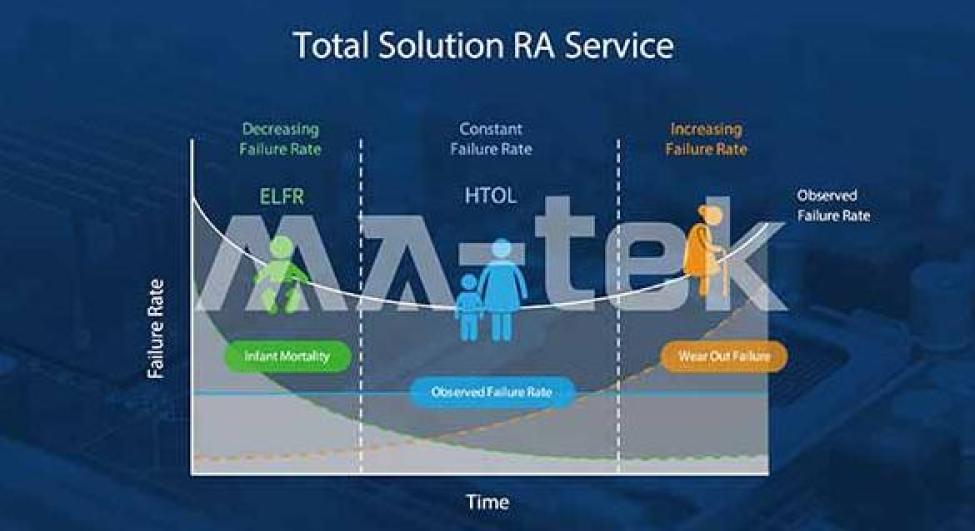
- Early Failure:Due to the design, materials, and processes not being fully stable, the failure rate is higher at this stage, but it gradually decreases with improvements. Early failure products can be eliminated through environmental stress screening (such as Burn-in) to improve yield.
- Random Failure:The product has entered a stable state, with a fixed failure rate that mainly depends on design and materials. Common failure causes at this stage include overuse (such as Electrical Over Stress, EOS) or environmental impacts, which can be assessed for reliability through life testing (such as HTOL).
- Wear Out Failure: When a product exceeds its designed lifespan, the failure rate increases over time. This stage can reduce the risk of failure through regular maintenance.
Accelerated life testing
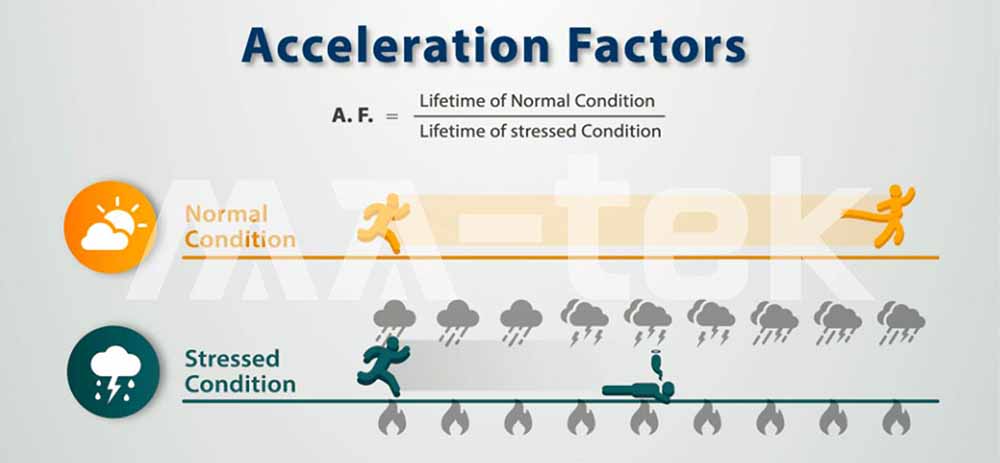
The design life of general products is often required to be more than one year, but if a complete life test is conducted directly in a room temperature environment, it will take too much time and cannot meet the demand for rapid market launch. Therefore, reliability testing will use Accelerated Stress Test conditions and Life Prediction models to shorten the verification timeline while still effectively estimating product life, assisting manufacturers in accelerating the development process.
Common acceleration factors include: electrical load, temperature, humidity, pressure, mechanical stress.Through these acceleration factors, engineers can simulate the reliability performance of products under long-term use in a relatively short period of time and quickly grasp potential failure risks.
Complete reliability testing and planning
After decades of development, many countries or international organizations have established various application standards based on the usage environment and conditions of different products, commonly referenced ones include IPC, MIL-STD, JEDEC, IEC, EIA, etc. In recent years, quite popular...Automotive electronics specificationsSuch as AEC-Q100 / 101 / 102 / 104 / 200 or ISO 16750, there are also many adopters.
According to the definition of reliability by the U.S. Department of Defense, excluding production defects and variations, the main factors affecting product quality and lifespan are: electrical load, temperature, humidity, pressure, contaminants, mechanical stress, etc. Through the testing and verification process, critical capabilities of the product can be identified, which can serve as a reference for product design, as well as an application for product quality level standards, and even be transformed into early failure product screening techniques to ensure the quality assurance level of shipped products.
In addition to influencing factors, sample size and confidence level are also considerations in life assessment. Unlike the AQL sampling method used in incoming and outgoing inspections, reliability testing is based on the rejection level LTPD (Lot Tolerance Percent Defective), taking into account the consumer's risk rate.
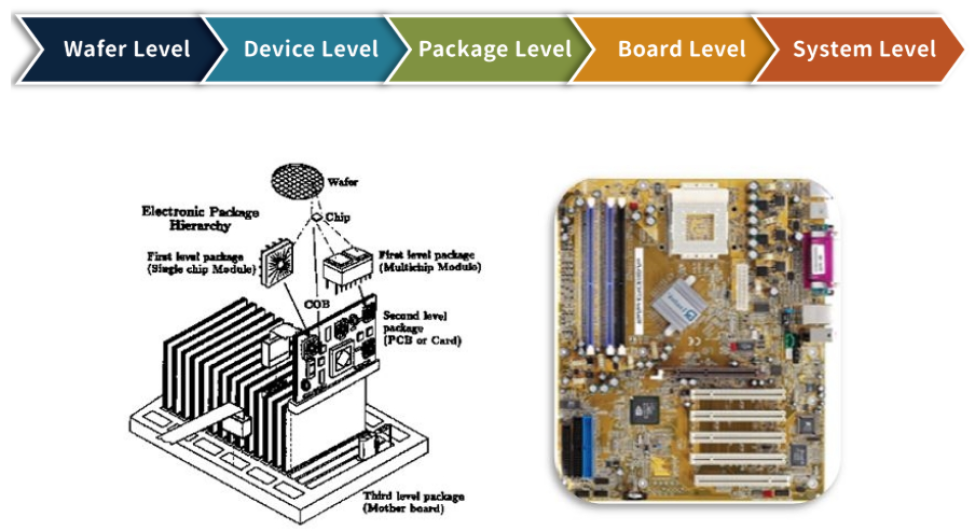
A. Up to 12000G; commonly 10000G, 0.2mS~0.25mS and 1500G 0.5mS.
A. Fixture design can be carried out according to customer requirements and Cyclic bending can be performed, but there is no synchronous strain gauge measurement function.
Q3. Can three-point and four-point bending be performed?
A. Can perform (special sizes require fixtures) IPC 9702/IPC 9704 three-point or four-point bending.
Q4. What are the dynamic measurement methods?
A. Paste single-axis or three-axis strain gauges for measurement or use Event detector/Data Logger for measurement.
Q5. What kind of FA can be done for product failure?
A. 3D X-Ray or red ink test.