
Analysis of material composition in the assessment of chemical analysis.
MA-tek receives a wide variety of customer experiment consultations and testing commissions. These numerous requests can mostly be divided into two categories: inquiries about physical and chemical properties, and requests for qualitative or quantitative analysis of samples. The former includes demands such as hardness (Hardness, H), viscosity (Viscosity), Young's modulus (Young's Modulus), refractive index (Refractive index), film thickness (Film Thickness), glass transition temperature (Tg), (linear) coefficient of thermal expansion (CTE), dielectric constant, transmittance, absorbance, reflectance, particle size distribution, melting point, and curing rate; the latter includes inspection of specific target substances in raw materials or products, as well as the identification and even quantitative testing of unknown substances or foreign particles that unexpectedly appear in processes or production lines.
For the detection of components in substances, it can usually be divided into two parts: obtaining qualitative information and quantitative concentration detection; however, regardless of the requirement, it is necessary to first clarify what type of substance the target is. Essentially, the target substances to be tested can be simply categorized into three types: elements, organic compounds, and ionic substances. After detailed discussions and determining the scope of the detection solutions that can be provided, different instruments, devices, or methods are recommended based on the questions, information, or needs provided by the client.
Metal analysis testing
In metal analysis testing, MA-tek can provide a variety of instruments for detection, including TEM/EDX and SEM/EDX, which belong to material analysis testing devices; XPS, XRD, XRF, and SIMS, which belong to surface analysis testing; and ICP-MS, GD-MS, ICP-OES, and even GF-AAS from the field of chemical analysis.
The instruments mentioned above can provide different analytical information in detection, with significant differences in precision, accuracy, and concentration linear range. Among them, the best detection capabilities are SIMS (ppb), GDMS (ppb), and ICP-MS (ppt-ppb); in addition to providing information on the lateral distribution of elements at different positions on the sample surface, XPS and SIMS can also explore depth profiling information by using ion beams. Furthermore, after comparing the XPS analysis results with spectral information in the database, it can further provide information on elemental bonding. After comparison with the database, XRF can simply provide alloy metal grade information and can be miniaturized to serve as a portable inspection device for rapid screening; most devices belonging to surface analysis or materials analysis fields usually do not require complicated sample pretreatment steps and can be tested directly in solid sample form, providing point and micro-area analysis; in contrast, chemical analysis instruments are mostly limited to testing only liquid samples, often requiring different pretreatment methods, such as microwave digestion or hot plate melting, to prepare the samples into liquid form before testing; although chemical analysis devices cannot provide point detection information, they can provide average results of the overall bulk concentration of the samples.
1-1. Inductively Coupled Plasma Mass Spectrometry ICP-MS
ICP-MS is currently recognized in the field of chemical analysis as the most sensitive system for metal detection, easily meeting detection requirements at the ppb concentration level; besides C, H, O, N, halogens, and gases, even non-metals or metalloids that are difficult to ionize usually have good sensitivity. In the face of complex sample matrix effects, it can not only destroy the sample matrix as much as possible through a high-temperature plasma source, but current ICP-MS systems are also equipped with Reaction Cells or Collision Cells integrated into the ion lenses system, using different functional collision or reaction gases, such as hydrogen, helium, or ammonia, to more effectively eliminate interference issues. Additionally, due to ICP-MS's technical characteristics, such as the ability to perform rapid mass spectrometry scans in a short time, multi-element detection analysis in an extremely short time, and a linear range close to 7-8 orders of magnitude, it has been widely applied in metal concentration detection across different fields.
Basically, ICP-MS is equipped with qualitative/semi-quantitative detection mode (Qualitative Analysis/Semi-Quantitative Analysis, SQ) and quantitative detection mode (Quantitative Analysis), which can provide full elemental scan information of the sample or accurate concentration information of specific elements, respectively; it also has less commonly used analytical functions, including Isotope Determination and the Isotope Dilution Method, which allows for precise concentration information without the need for calibration curves after using concentrated isotopes; these two applications are currently rarely mentioned or applied outside of geological-related testing. In semi-quantitative mode, concentration calculations are based on internal system information, combined with calibration using a single-point concentration standard, thus the provided concentration is information on the Order. In detecting elements, usually only one isotope is selected as the detection mass, so when that mass number encounters polyatomic interference or isobaric interference, it may yield incorrect results. The main function of the SQ mode is to obtain as much concentration information of various elements as possible in a single measurement for reference. To obtain accurate results, it is still recommended to conduct analysis in quantitative mode, where the detection concentration falls within the linear range of the calibration curve, and various verification tests are conducted, such as matrix effect assessment, sample repeat testing, batch verification of standard reference materials, blank sample repeat testing, or using secondary source standard materials for verifying the calibration curve samples, to confirm that the obtained results are more accurate. However, experience has shown that some samples with excessively high matrix concentrations may still exceed the interference removal capability of general ICP-MS, at which point it may be necessary to seek other analytical instruments or high chemical resolution ICP-MS equipped with a triple quadrupole system for comparative confirmation.
ICP-MS is limited to the requirement that samples must be introduced in liquid form; therefore, solid samples must be pre-treated into liquid samples before they can be analyzed. The most commonly used pre-treatment methods are simple hot plate melting and microwave-assisted heating devices, which use different acids or oxidants and high temperatures to break down the sample matrix and convert it into a liquid sample. Therefore, if the sample cannot be digested during the pre-treatment process, such as ceramic-related materials, sintered carbides, acid and alkali-resistant plastics, or polymers, they cannot be effectively dissolved and measured. In such cases, it is usually necessary to seek high-temperature furnaces or alkaline fusion furnaces to process the sample.
2. Ionic Species Detection Analysis
The scope of ionic species is relatively simple compared to metal and organic substance detection, and can mainly be simply divided into halogens that belong to anions, including fluoride ions, chloride ions, bromide ions, and iodide ions, as well as acid anions, which can be simply divided into inorganic acid-related, including nitrate, nitrite, sulfate, phosphate, and organic acid-related, including formate, acetate, and weak organic acid anions. Such analytical tests are usually seen in the residual detection requirements on object surfaces, and sometimes the IPC TM650-2.3.28 method is used for sample pretreatment. The samples after pretreatment are then tested using anion chromatography systems or cation chromatography systems.
3. Organic Compound Detection and Analysis
In the detection of organic compounds, the instruments commonly used for analysis include FTIR, Raman, GCMS, TOF-SIMS, and LCMS. When the sample concentration is high or when analyzing the surface of objects, it is generally recommended to first use FTIR or Raman; in addition to being simple, inexpensive, and fast, they can also provide information about functional groups that other detection instruments cannot offer, and by comparing with databases, they can suggest possible qualitative information. However, when the sample composition is more complex or the concentration is lower, a mass spectrometry system with better sensitivity will still be needed. TOF-SIMS mainly provides data with spatial resolution and high mass resolution, and can be directly applied to the analysis and detection of materials or finished product surfaces.
3-1. Gas Chromatography Mass Spectrometer
In traditional GCMS detection, for solid or powder samples, an appropriate solvent is first chosen to dissolve the sample, and then a syringe is used to extract the sample, which is injected into the GCMS for qualitative or quantitative detection. It mainly targets volatile, non-polar small molecule organic compounds (MW<550), and the samples usually need to have a certain degree of thermal stability; otherwise, there may be signs of sample degradation in the measured signal, resulting in phenomena such as signal splitting. The main problem faced is that when dealing with unknown substances, it is often difficult to determine whether the chosen solvent can effectively and completely dissolve the sample. Therefore, polar, non-polar, and mixed solvents are often selected for testing to increase the completeness of the experiment, but this also increases the time and cost required for the experiment. Additionally, since the components of the solvent used usually form a very obvious solvent peak in the chromatogram, if the solute itself has components similar to the solvent, the analysis results can easily be interfered with in terms of retention time/elution time. Another issue faced is that the solvent used, relative to the solute, will form a very obvious solvent peak in the chromatogram, which can interfere with species that have retention times/elution times close to it. For example, in Figure 1, for a fruit peel and pulp sample, the samples were first diluted 50 times with THF before being tested; the results of the two samples and the THF background signal are listed in the chromatogram. In the THF background signal, a significant signal peak can be seen at 4-7 minutes, which corresponds to the chromatograms of the two samples. Although there are still discernible signals before and after the chromatograms of the two samples, the signal at 4-7 minutes may be misjudged due to being buried in the large background signal.
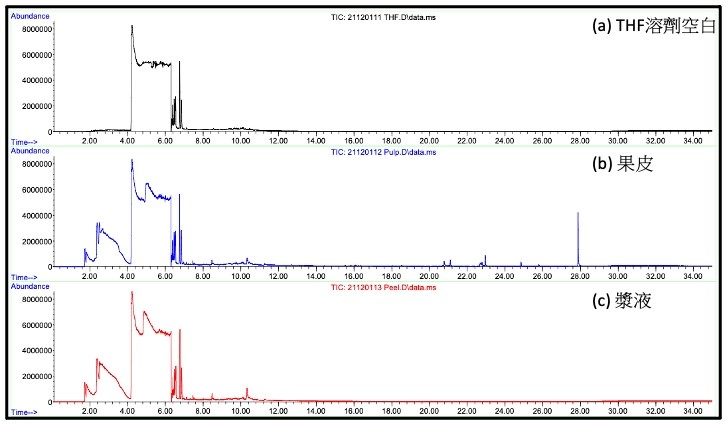
Figure 1 The effect of THF solvent peak in GCMS. (a) THF solvent blank; (b) peel sample; (c) slurry sample.
Therefore, another commonly considered workaround at present is based on the volatile characteristics of organic substances when heated. By directly heating or using IR lamps to provide thermal energy to the sample, the organic substances can vaporize, gasify, decompose, or desorb from the sample, and then the generated outgassing can be introduced into GCMS for analysis using inert gas. For lower concentration or slower volatile substances, they can be collected and concentrated in-line using adsorbents or liquid nitrogen before measurement. The applied desorption temperature can be set based on the actual temperature when the customer's problem occurs, or according to the actual process or reaction temperature conditions. It can also simply be set in the range of 250-300 degrees Celsius, as most organic substances tend to vaporize and desorb into gaseous substances at around 300 degrees Celsius. Usually, lower desorption temperatures will moderately extend the sample collection time due to the reaction rate, while higher temperatures can increase the desorption rate and shorten the sample collection time. However, temperatures above 300-350 degrees Celsius may start to cause organic substances to decompose, so experiments cannot simply be set at higher temperatures. Some laboratories that already have GC-MS devices can even set up their own front-end thermal desorption systems, applying temperatures of 300-450 degrees Celsius to the samples, and connecting them with collection devices and GCMS to achieve functionality similar to commercially available thermal desorption gas chromatography mass spectrometry (TD-GC-MS).
Polar substances, ionic substances, and larger organic compounds, such as polymers or resins, are expected to be less suitable. Additionally, solutions containing inorganic acids or inorganic bases are also unsuitable because they can corrode the metal components in pipelines and instrument devices at high temperatures. If the metal content in the solution is too high, such as in electroplating solutions, there are concerns that metals may deposit on interface metal cones, pipelines, or capillaries at high temperatures, and such samples are usually rejected by GCMS laboratories. Although these substances can be attempted to be extracted into an organic phase through liquid-liquid extraction pre-treatment before detection, the organic substances present in aqueous samples are generally expected to be more polar organic compounds. Under the premise of polar mutual solubility, their distribution coefficient in the organic phase is often relatively low, so the proportion that can be extracted into non-polar solvents is limited, likely resulting in a non-detectable (ND) outcome. Some higher molecular weight organic compounds, such as polymers or resins, due to their stronger cross-linked structures and higher molecular weights, are generally difficult or impossible to measure under normal conditions. Higher temperatures may need to be applied to the samples to break bonds and form fragments of specific structures, which can then be compared against a polymer database to infer what type of polymer substance it might be.
This type of system, which heats the sample and uses a mass spectrometer as the detection system (Hyphenation System), can provide different information about the analytes when the component functions vary slightly. The analytical systems used can be simply divided into two main categories: one is the thermal desorption gas chromatography mass spectrometry (TD-GCMS) used to provide qualitative and quantitative detection information of analytes in the sample, and the pyrolysis gas chromatography mass spectrometry (Py-GCMS), and the other includes thermal desorption spectrometry (TDS), temperature programmed desorption system (TPD), and thermal gravity mass spectrometry (TG-MS), which mainly provide information on changes over time and investigate thermal desorption behavior. Figure 2 is a simplified schematic diagram of its structure. The main difference between TD-GCMS and Py-GCMS lies in the heating temperature, allowing them to identify and measure small molecular organic compounds and larger molecules, respectively. Since the parameters used in GCMS are mostly the same or similar, the results obtained in different laboratories have a relatively high comparability. For example, the majority of the GC columns used are DB-5 related columns. TPD can raise the temperature of the existing GC-MS column, allowing it to serve merely as a bypass connection. However, in actual experiments, the results obtained still indicate that when detecting water vapor and hydrogen gas, there is still a possibility of repeated adsorption/desorption on the GC column, leading to results that do not meet customer expectations. The TG-MS system, which connects TGA and mass spectrometry, can record weight loss at various time points in the TGA part, enabling calculations of concentration/desorption amount. However, due to the use of general commercial TGA systems, the sample pans are mostly ceramic crucibles with a diameter of 4mm, which limits the amount/volume of samples that can be placed on the machine at one time. TDS, on the other hand, places the sample in a vacuum and provides thermal energy to the sample using IR lamps, which results in longer detection times and expensive testing costs. However, for the signal measurement of hydrogen and water vapor mentioned above, it may be the most accurate choice among the three.
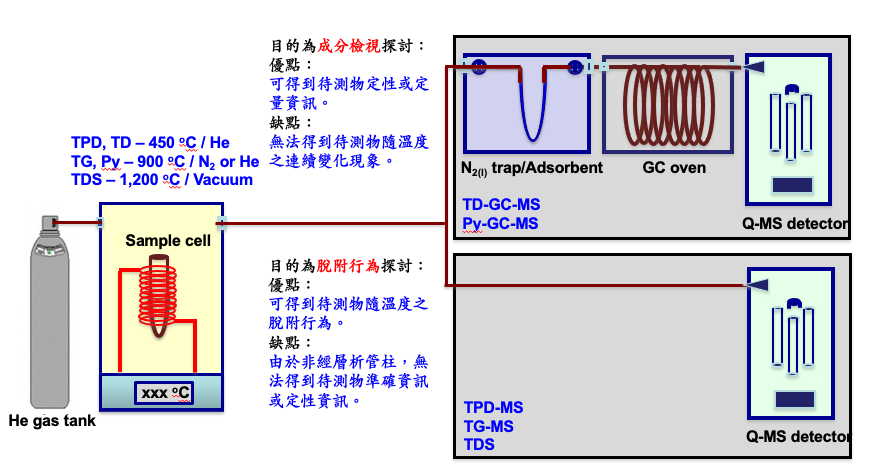
Figure 2 Schematic diagram of different thermal supply devices and mass spectrometry coupling systems.
3-2. Liquid Chromatography-Mass Spectrometry (LC-MS)
Liquid chromatography-mass spectrometry can be used to measure polar small molecules or macromolecules in solution. Due to the use of a milder and lower temperature ion source compared to inductively coupled plasma mass spectrometry, it is referred to as a soft ionization system, and the ions detected will reflect their original charge state in the solution.
The parameter settings during instrument measurement and the variety of LC analysis columns used for sample separation often result in significant differences in results obtained between different laboratories; sometimes even within the same laboratory, different members may obtain vastly different results when using different parameters. These reasons lead to the current lack of random database systems in LC-MS instrument setups, with more common databases being those related to pesticide and drug testing laboratories, making it very difficult to use them solely as qualitative analysis devices. Common organic mass spectrometry includes Single Quadrupole Mass Spectrometry (LC-MS), Triple Quadrupole Mass Spectrometry (LC-MS/MS), and Quadrupole-Time of Flight Mass Spectrometry (q-TOF). Among them, q-TOF, due to its excellent mass resolution, can be used for structural analysis of target compounds when combined with appropriate experimental design, statistical software applications, and online database comparisons (such as MASCOT). It has been widely used in various omics analyses, such as structural analysis of biomolecules or proteins in proteomics. The Triple-Q system generally only has unit resolution, but when combined with its Select Ion Monitoring (SIM) or Multiple Reaction Monitoring (MRM) modes, it can achieve better sensitivity and meet the accurate quantification analysis needs for small organic molecules, thus being widely used in pharmaceuticals or metabolite detection fields. Currently, MA-tek mainly possesses a high-temperature gas-assisted Electro-spray ionization (ESI) LC-MS/MS system, which is typically used in conjunction with reverse phase chromatography (RP) columns to detect polar small organic molecules. The MS2 scanning mode of LC-MS/MS can provide full mass spectra (m/z < 4000) for samples; if only differences between samples are to be compared, corresponding information can still be provided. For known specific mass fragment information of the target compound, quantification detection of the target compound can be attempted using the aforementioned SIM or MRM modes.
Compared to the detection of macromolecular substances such as polymers or resins in GCMS, solid samples are heated and detected by fragment molecules; LC-MS, which can only perform solution injection detection, typically detects macromolecules. For example, in the case of proteins, nucleic acids, or amino acids, proteins can generate charges through the dissociation of functional groups on amino acids in appropriate buffer solutions. Therefore, the same molecule may carry multiple charges, forming Multiple Charged Ions. By inferring the number of charges based on the different signal positions, the possible molecular weight can be recalculated through the system's deconvolution function. Figure 3 shows an example of a metal sulfur protein with a mass number of approximately 6700 Da, indicating that the obtained result is roughly equal to the estimated molecular weight. Another commonly used method in molecular biology or biochemistry is to perform enzymatic hydrolysis on proteins using trypsin to degrade the originally larger and longer structures, and then deduce the possible original amino acid sequences and structures from the resulting amino acid fragments. Due to the considerable difficulty in determining information from enzymatic hydrolysis and multiple charges, as well as the requirements for other devices, such detection services are currently mostly provided only in biochemistry or omics-related laboratories.
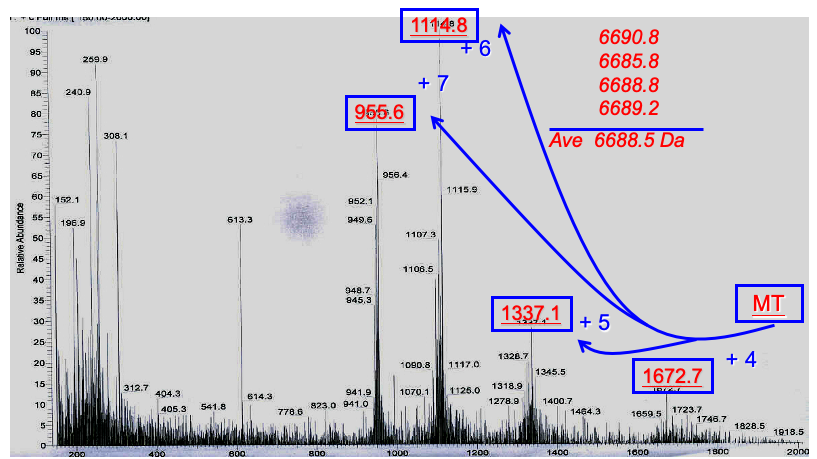
Figure 3 estimates the molecular weight of metal sulfur proteins using multiple charged ions by LCMS.
Currently, due to the lack of a database for direct signal comparison in LCMS, the detection and analysis of organic compounds will prioritize the consideration of the GCMS system. Although LCMS can still provide information different from GCMS in the sample, the current analysis services of MA-tek are still limited to: (a) analysis of differences and similarities between samples, or comparison between OK and NG items, (b) analysis and detection of specific compounds that can provide standard or reference materials; (c) analysis of residual detection of water-soluble pollutants or foreign substances, and (d) samples that cannot be analyzed by GCMS but still hope to have mass spectrometry data for research discussion.
For the testing of the provided samples, MA-tek can offer services that typically include testing and analysis using customer-specified instrument systems, as well as the investigation and analysis of unknown components in the samples or foreign substances.