
[Year 113] MA-tek Industry-Academia Cooperation Project is now strongly recruiting applications, starting from May 7!
MA-tek has long been assisting the high-tech industry with the analytical testing needs of advanced technologies, earning praise and trust from the industry. We also understand that academic institutions bear the heavy responsibility of nurturing the future development of advanced technologies and require more research resources. MA-tek hopes to contribute more to society and aims to assist more outstanding research and development projects to be realized by enhancing the quality of analytical testing during the R&D process.
Therefore, starting from the year 110, an annual investment of NT$20 million has been allocated to establish the MA-tek Industry-Academia Cooperation Program, which is expected to subsidize 20 projects each year. The program seeks research projects focused on the development of high-tech products and themes related to manufacturing, packaging, testing, and systems, utilizing advanced analytical testing technologies to support academic institutions in the preliminary research and development of innovative components, materials, and concepts.
To this end, MA-tek publicly invites outstanding scholars in related research fields to collaborate with us by providing high-end analytical instrument services, combining the research resources of academic institutions to promote basic and applied research, and jointly create a win-win situation for industry and academia.
Target applicants
Including National Taiwan University, National Taiwan University of Science and Technology, National Taiwan Normal University, National Tsing Hua University, National Yang Ming Chiao Tung University, National Central University, National Chung Hsing University, National Cheng Kung University, National Sun Yat-sen UniversityThe nine universities. The project leader must be employed by the institution where the service center is located, and each person is limited to one application per year.
2024 Annual Plan Schedule
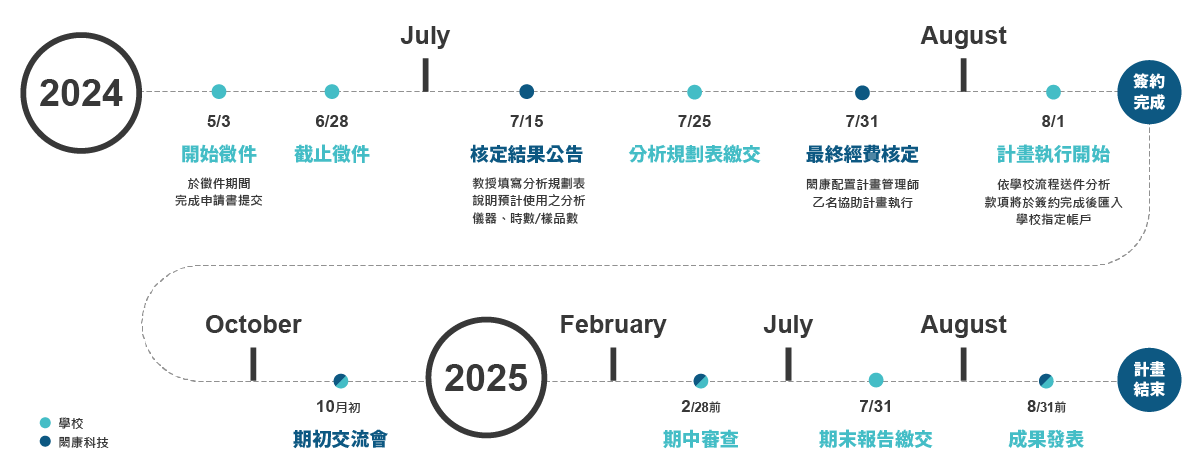
- Application period: From May 7, 113 to June 28, 113.
- Announcement of Results: The selection results will be notified to each service center and applicants by July 16, 113.
- Project execution time: From August 1, 113 to July 31, 114.
Selection Focus
- Research topics prioritize related fields such as quantum computers, compound semiconductors, advanced processes, optoelectronic materials, manufacturing packaging, and new energy.
- With innovative or future application development potential.
- The execution of the project requires the use of the analytical instruments provided by MA-tek.
The subsidy items are provided by MA-tek and include the following advanced analytical testing services, divided into 9 major fields based on the equipment.
1. Non-destructive structural observation (3D X-ray, SAT, Thermal EMMI)
2. Microstructure and Composition Analysis (Sample Preparation, High-Resolution TEM, SEM, FIB, EDS, EBSD, EELS, NBD, SAD)
3. Impurity concentration detection (SIMS, SRP, SCM, XPS, Auger)
4. Pollution and Trace Detection (TOF-SIMS, XPS, FTIR, XRF)
5. Liquid TEM Analysis (K-kit)
6. Component-level electrical measurement and defect localization (C-AFM, Nano-probing, EBIC/EBAC, PEM, OBIRCH, Thermal EMMI)
7. ESD (HBM, MM, CDM, Latch-up, TLP, EOS)
8. Reliability testing (HTOL, HAST, TCT, BLT, TS, Vibration, Shock, H2S corrosion, AMR/AMI, HRTB, etc.)
9. Physical chemistry analysis (ICP-MS, TGA, LC-MS, etc.)
Q&A
1. About the costs
Q1. How should the budget for the application plan be allocated?
The budget for the research project does not need to be prepared in advance. Applicants only need to detail the experimental ideas and the instruments that may be used. Subsequently, technical experts from MA-tek will assist in planning the quantity or time of equipment usage and estimate the funding accordingly.
Q2. Are there any rules or restrictions on the budget allocation of the project?
MA-tek's industry-academia cooperation program mainly aims to enhance the quality of analytical testing in the research and development process. Therefore, the overall budget allocation will be arranged as follows: (This part is only a suggestion for reference, and applicants can estimate the proportions themselves, with the final evaluation conducted by the review specialists.)
- 70% - Equipment usage fee (MA-tek)
- 20% - School Management Fee
- 10% - Personnel, materials, and other business expenses (it is recommended to use existing manpower to reduce costs)
Q3. What is the subsidy method and process?
The application process will follow the flowchart below, with each project assigned a MA-tek project manager to assist with technical communication and project execution.
2. Others
Q1. What are the limitations of the role of the host?
The project host is limited to full-time professors from nine universities (National Taiwan University, National Taiwan University of Science and Technology, National Taiwan Normal University, National Tsing Hua University, National Yang Ming Chiao Tung University, National Central University, National Chung Hsing University, National Cheng Kung University, National Sun Yat-sen University, including their affiliated schools), including full, associate, and assistant professors, but excluding part-time professors and lecturers.
Q2. How is the distribution of results (intellectual property rights) divided?
In principle, the distribution of the results will be 50% for each party; the details will be further discussed due to different regulations of each university and the nature of each project.
Q3. What are the equipment requirements?
Please list in detail the equipment to be used for the project execution in the application form. MA-tek will prioritize the assessment using existing equipment, and MA-tek's technical experts will also provide suggestions during the discussion phase after the project is selected. During the project execution phase, MA-tek's project management will assist in the conduct of experimental analysis and the setting of experimental parameters. Project members are also welcome to come on-site to conduct experimental analysis together.
Q4. What is the purpose of MA-tek launching this cooperation program?
The main idea of this collaboration project is that MA-tek's Chairman, Hsieh Yong-fen, has served as the president of the Tsinghua University Alumni Association and has maintained close ties with the academic community for a long time. He is well aware of the shortcomings in research funding for academic institutions and the lack of access to high-end or expensive equipment resources. Therefore, he instructed MA-tek to allocate funds each year so that outstanding laboratories in academia can enjoy industry-standard analytical testing services, supporting and assisting more outstanding R&D projects to be realized.
Q5. If it is not in the fields of quantum computers, compound semiconductors, advanced processes, optoelectronic materials, and manufacturing packaging, can one still apply?
Yes, any research with innovative or future application development potential that uses MA-tek's high-end analytical instruments is welcome for professors to apply.
For detailed information, please refer to the project description. If you have any related questions about the project content, please contact the technical liaison:
- Technical contact window: Mr. Chen Hongren | 03-611-6678 ext.3250 |JDP@ma-tek.com
Those who wish to apply for MA-tek's industry-academia subsidy, please useMA-tek project proposal formatPrepare the documents and email the electronic files to the MA-tek administrative window during the submission period. Late submissions, incomplete documents, or those that do not meet the requirements will not be accepted.
- MA-tek submission contact: Ms. Chiu Pei-Ju | 03-611-6678 ext.3815 |JDP@ma-tek.com
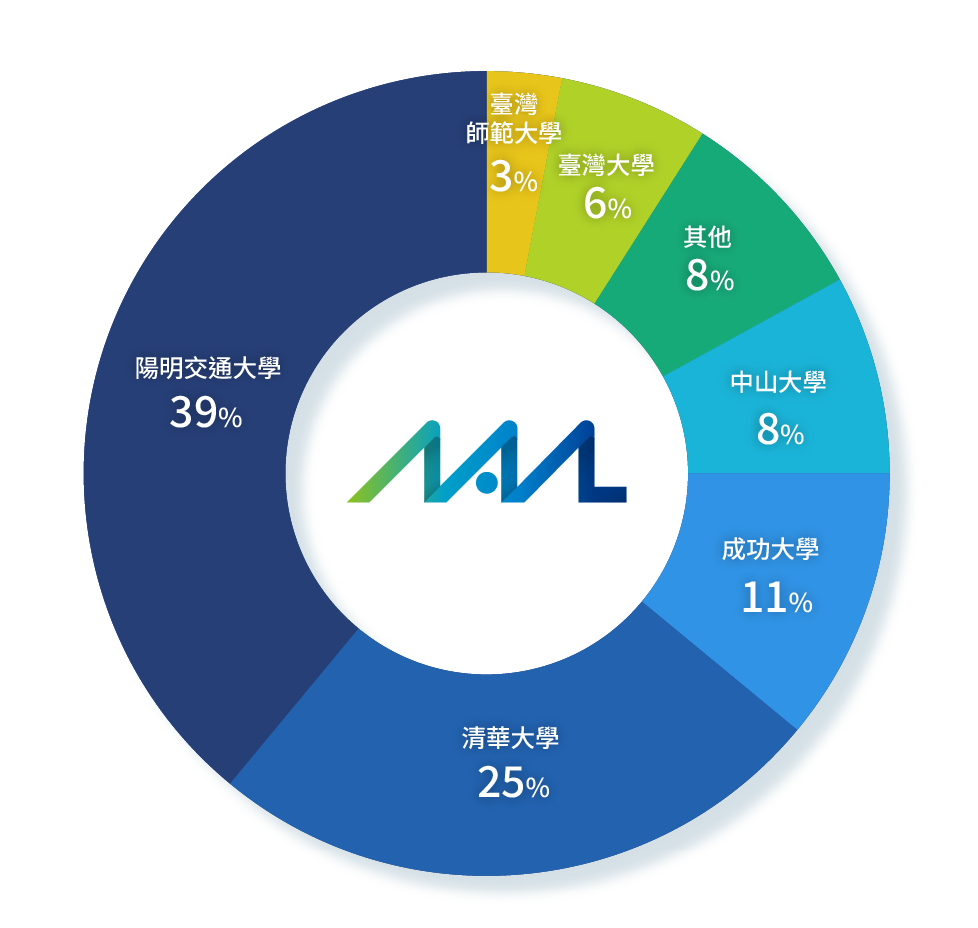
Proportion of submissions from each school
Approved Research Project List for the 113th Year
Starting from May 7, 2024, MA-tek publicly solicits industry-academia collaboration projects, with the deadline on June 28. During this period, multiple project proposals were received. The research topics of these proposals cover a wide range, including semiconductor materials, optoelectronic technology, component processing, battery technology, memory technology, sensor technology, secure chips, high-entropy materials, and applications of artificial intelligence in various technological fields. These proposal applications not only demonstrate the diversity of domestic academic research but also reflect the extensive application and development trends of modern technology in cutting-edge fields. The submission ratios from various schools for this year's 113th collaboration project selection are shown in the attached figure.
MA-tek hopes that through the research funding provided by this industry-academia collaboration project, it can assist in accelerating the execution of professors' forward-looking research plans, enhance the quality of analytical testing in domestic academic research, and promote the development of advanced technologies in the future.
Among the many excellent project applications, after a rigorous evaluation by MA-tek's internal expert team, each project's innovative applications, technical challenges, and industrial significance were carefully assessed and discussed, resulting in the following approved list of selected collaboration projects for this session.
| University | Department / Institute | Project Leader | Project Name |
|---|---|---|---|
| National Taiwan University |
Institute of Electrical Engineering |
Liu Chih-Wei | Material Characterization of Stacked Si/Ge/GeSi Nanosheets/Ultrathin Bodies, Oxide Semiconductor Nanosheets, CFETs, 3D FeFETs and IGZO GAA Nanosheet FETs. |
| National Taiwan University |
Keypoint Technology Institute Component Materials and Heterogeneous Integration Degree Program |
Li Min-Hung | Superlattice ferroelectric hafnium zirconium memory for low Earth orbit satellites |
| Taiwan University of Science and Technology | Department of Industrial Management | Hsu Chia-Yu | Research on the Application of Artificial Intelligence in TCAD Process Structure Simulation Generation for Automatic Measurement |
| National Yang Ming Chiao Tung University | Electronics Research Institute | Li Pei-Wen | Study on Charge Transport and Stability of Photon-Enhanced Germanium Quantum Bit Devices |
| Yang Ming Chiao Tung University | Electronics Research Institute | Tsui Ping-Yueh | Development of Process Technology for Oxide Layer at the Bottom of Thick Grooves |
| National Yang Ming Chiao Tung University | Electronics Research Institute | Hung Jui-Hua | High-speed growth of GaN epitaxial films using TMGa and its related device applications |
| National Yang Ming Chiao Tung University | Electronics Research Institute | Ko Ming-Dou | Design and Verification of ESD Protection Circuit for GaN Process |
| National Yang Ming Chiao Tung University | Electronics Research Institute | Chen Kuan-Neng | Research on High Alignment Precision Technology for Silicon Wafer Bonding Assisted by AI |
| Yang Ming Chiao Tung University | Department (Institute) of Electronic Physics | Chao Tien-Sheng | Research on disposable programmable memory of non-volatile fuse applied to IoT security chips |
| National Yang Ming Chiao Tung University | Department of Electronic Physics | Chou Wu-Ching | Epitaxy and Characterization of Two-Dimensional Semiconductor Heterostructures |
| National Yang Ming Chiao Tung University | Department of Photonics Engineering | Kuo Hao-Chung | Indium Phosphide Laser and Silicon Photonics Integration |
| National Yang Ming Chiao Tung University |
Materials Science and Engineering |
Chen Chih | Design of 3D Integrated Circuit Heterogeneous Bonding Process Using In-situ Heating Atomic Force Microscopy |
| National Yang Ming Chiao Tung University |
International Semiconductor Industry Academy |
Wu Tien-Li | Reliability and failure mechanism analysis of high voltage (>1.2KV) GaN power devices applied in electric vehicles |
| Tsinghua University |
Electrical Engineering Department and Chief of R&D |
Chiu Po-Wen | UV-ALD deposition of ultra-thin In2O3 oxide semiconductor channel materials and FLA defect filling engineering (II) |
| Tsinghua University |
Department of Materials Science and Engineering |
Lin Tzu-Ying | Forward-looking space application thin-film photovoltaic technology development |
| Tsinghua University |
Institute of Electronics Engineering / Semiconductor College Components |
Hsu Shuo-Hung | ESD Characteristics for GaN-based technology |
| National Tsing Hua University |
Department of Power Mechanical Engineering |
Fang Wei-Lun | Development and performance verification of micro piezoelectric sensors and environmental sensing testing technology |
| National Tsing Hua University |
Department of Engineering and System Science |
Wu Yung-Hsien | Hybrid memory that integrates the advantages of ferroelectric memory and flash memory to achieve low-power high-density storage. |
| National Tsing Hua University |
Department of Engineering and System Science |
Chen Tsan-Yao | Enhancing the electron injection efficiency at the interface of organic semiconductors and oxide semiconductors using single atomic layer metal heterojunction technology. |
| National Cheng Kung University |
Department of Materials Science and Engineering |
Chung Sheng-Heng | Development of high energy density lithium metal all-solid-state battery materials and component analysis technology |
|
The order of the list is sorted by school name. |
|||
Congratulations to the above-approved projects. MA-tek will send out notification letters on July 16, 2024, and will actively contact the project leaders within a week to discuss the subsequent project execution items and the schedule for signing the contract.
MA-tek supports forward-looking technology research in various fields and has selected 20 collaborative projects. For the projects that were not selected this time, MA-tek also provides strong support by offering analysis services at discounted prices for academic research. For more information, please feel free to contact the respective technical units.
Project contact window
- Technical contact window: Mr. Chen Hongren | 03-611-6678 ext.3250 |JDP@ma-tek.com
- MA-tek submission contact: Miss Chiu Pei-Ju | 03-611-6678 ext.3815 |JDP@ma-tek.com
Announcement date: July 16, 2024