
The approved list of the 115th "MA-tek Industry-Academia Cooperation Program" is announced!

MA-tek has long been assisting the high-tech industry with the analytical testing needs of advanced technologies, earning praise and trust from the industry. We also understand that academic institutions bear the heavy responsibility of nurturing the development of future advanced technologies and require more research resources. MA-tek hopes to contribute more to society and aims to enhance the quality of analytical testing in the R&D process to help more outstanding R&D projects come to fruition.
Therefore, starting from the year 110, an annual investment of NT$20 million is established.MA-tek Industry-Academia Cooperation ProgramIt is expected to subsidize 20 projects each year, soliciting research projects focused on the development of high-tech products and themes such as manufacturing, packaging, testing, and systems, while utilizing advanced analytical testing technologies to support academic units in the preliminary research and development of innovative components, materials, and innovative concepts.
To this end, MA-tek publicly invites outstanding scholars in relevant research fields to collaborate with us by providing high-end analytical instrument services, combining the research resources of academic institutions to promote basic and applied research, and create a win-win situation for both industry and academia.
Target applicants
Including National Taiwan University, National Taiwan University of Science and Technology, National Taiwan Normal University, Taipei Medical University, National Tsing Hua University, National Yang Ming Chiao Tung University, National Central University, National Chung Hsing University, National Cheng Kung University, National Sun Yat-sen UniversityThe ten universities. The project leader must be employed by the institution where the service center is located, and each person is limited to applying for one project per year.
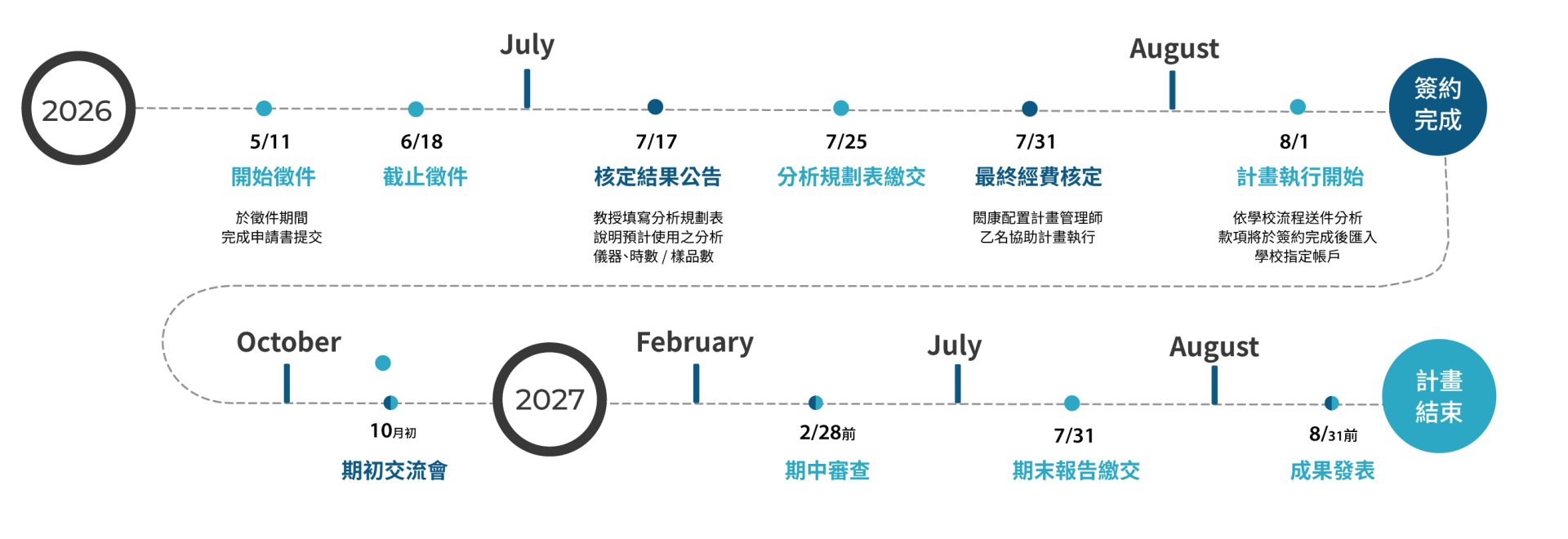
2026 Annual Plan Schedule
- Application period: From May 11, 115 to June 18, 115.
- Announcement of Results: The selection results will be notified to each service center and applicants before July 17, 115.
- Project execution time: From August 1, 115 to August 31, 116.
Selection Focus
- Research topics will prioritize advanced processes, manufacturing packaging, compound semiconductors, optoelectronic materials, new energy, quantum devices, AI chips, silicon photonics, and nanobiomedicine.
- With innovative or future application development potential.
- The execution of the project requires the use of the analysis instruments provided by MA-tek.
The subsidy items provided by MA-tek include the following advanced analytical testing services, categorized into 9 major fields based on the instruments and equipment:
1. Non-destructive structural observation (3D X-ray, SAT, Thermal EMMI)
2. Microstructure and Composition Analysis (Sample Preparation, High-Resolution TEM, SEM, FIB, EDS, EBSD, EELS, NBD, SAD)
3. Impurity concentration detection (SIMS, SRP, SCM, XPS, Auger)
4. Pollution and Trace Detection (TOF-SIMS, XPS, FTIR, XRF)
5. Liquid TEM Analysis (K-kit)
6. Component-level electrical measurement and defect localization (C-AFM, Nano-probing, EBIC/EBAC, PEM, OBIRCH, Thermal EMMI)
7. ESD (HBM, MM, CDM, Latch-up, TLP, EOS)
8. Reliability testing (HTOL, HAST, TCT, BLT, TS, Vibration, Shock, H2S corrosion, AMR/AMI, HRTB, etc.)
9. Physical and Chemical Analysis (ICP-MS, TGA, LC-MS, etc.)
Q&A
1. About Costs
Q1. How should the budget for the application plan be allocated?
The budget for the research project does not need to be prepared in advance; the applicant only needs to provide details.Experimental concepts and possible instruments to be usedSubsequently, technical experts from MA-tek will assist in planning the quantity or duration of equipment usage, and estimate the budget accordingly.
Q2. Are there any rules or restrictions on the budget allocation for the project?
MA-tek's industry-academia collaboration program mainly aims to enhance the quality of analytical testing in the R&D process. Therefore, the overall budget allocation will be arranged as follows: (This part is only a suggestion for reference; applicants can estimate the proportions themselves, and the final evaluation will be conducted by the review specialists.)
- 70% - Equipment usage fee (MA-tek)
- 20% - School Management Fee
- 10% - Personnel, materials, and other business expenses (it is recommended to use existing manpower to reduce expenses)
Q3. What is the subsidy method and process?
The application process will follow the flowchart below, and each project will be assigned a MA-tek project manager to assist with technical communication and project execution.
2. Others
Q1. What are the limitations of the role of the host?
The project host is limited to full-time professors from ten schools (National Taiwan University, National Taiwan University of Science and Technology, National Taiwan Normal University, Taipei Medical University, National Tsing Hua University, National Yang Ming Chiao Tung University, National Central University, National Chung Hsing University, National Cheng Kung University, National Sun Yat-sen University, including their affiliated schools), including associate, assistant, and full professors, but excluding part-time professors and lecturers.
Q2. How is the distribution of results (intellectual property rights) handled?
In principle, the distribution of the results will be 50% for each party; the details will be further discussed due to the different regulations of each university and the nature of each project.
Q3. What are the equipment requirements?
Please list in detail the equipment to be used for the project execution in the application form. MA-tek will prioritize the evaluation using existing equipment, and MA-tek's technical experts will also provide suggestions during the discussion phase after the project is selected. During the project execution phase, MA-tek will assist in the experimental analysis and the setting of experimental parameters through project management. Project members are also welcome to come on-site to conduct experimental analysis together.
Q4. What is the purpose of MA-tek launching this collaboration program?
The main idea behind this collaboration project is that MA-tek's Chairman, Hsieh Yong-fen, has served as the president of the Tsinghua University Alumni Association and has maintained close ties with the academic community for a long time. He is well aware of the shortcomings in research funding for academic institutions and the lack of access to high-end or expensive equipment resources. Therefore, he instructed MA-tek to allocate funds each year to allow outstanding laboratories in academia to enjoy industry-standard analytical testing services, supporting and assisting more outstanding R&D projects to be realized.
Q5. If it is not quantum computers, compound semiconductors, advanced processes, optoelectronic materials, and manufacturing packaging fields, can we apply?
Yes, any research with innovative or future application development potential that uses MA-tek's high-end analytical instruments is welcome for professors to apply.
For detailed information, please refer to the project description. If you have any related questions regarding the project content, please contact the technical liaison:
- Technical contact window: Mr. Chen Hong-ren | 03-611-6678 ext.3250 |JDP@ma-tek.com
Those who wish to apply for the MA-tek industry-academia subsidy should prepare the document in the MA-tek project proposal format and email the electronic file to the MA-tek administrative office during the application period. Late submissions, incomplete documents, or those that do not meet the requirements will not be accepted.
- MA-tek submission contact: Miss Qiu Peiru | 03-611-6678 ext.3815 | JDP@ma-tek.com
MA-tek's industry-academia cooperation program has entered its sixth phase, continuing to support domestic universities in investing in forward-looking technology research with corporate R&D resources, promoting industry-academia collaboration and technological innovation. This phase115 program begins on 2026-5-7Starting from the date of announcement, until6-18The deadline for submission is on the day of the month, and the project execution period is115-8-1 to 116-7-31.
This period's project applications are quite enthusiastic, with the number of submissions reaching a new high. Proposals from various schools cover semiconductor materials, advanced components and packaging, quantum computing, silicon photonics, new energy, space radiation, memory, sensors, secure chips, composite materials, and nanomedicine.K-kitand artificial intelligence and other technology fields, fully demonstrating the abundant research energy and innovative results of the domestic academic community.
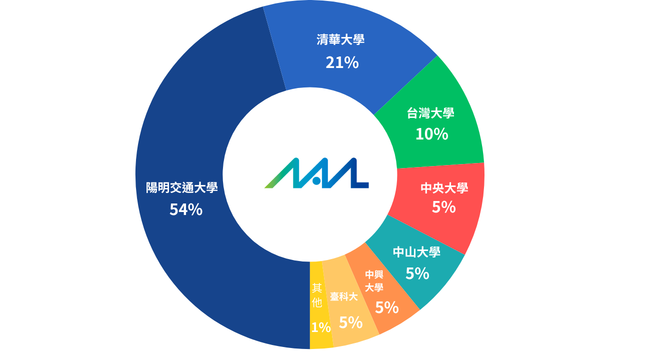 Proportion of submissions from each school
According to the application statistics, the schools with the highest number of proposals are in order: National Yang Ming Chiao Tung University, National Tsing Hua University, and National Taiwan University. Among them, research proposals in the field of semiconductor technology are the most numerous, including topics such as advanced components, processes, materials, packaging, and circuit design, accounting for the total number of applications.52%; secondly, new energy18%and silicon photonics15%The submission ratios of each school are shown in the attached image.
In recent years, in the global net-zero transition andAIHigh Performance Computing (HPCUnder the impetus of rapid development, new energy and silicon photonics have become the emerging technologies with the greatest development potential. New energy research covers efficient batteries and new energy storage materials, while silicon photonics responds toCo-Packaged Optics(CPOWith the demand for high-speed data transmission, it has become an important core technology for the next generation of optoelectronic integration.
To deepen the layout of silicon photonics analysis and testing, and to create a complete optoelectronic verification service platform, MA-tek has recently launched a series of investments in international-level silicon photonics wafer and chip analysis verification platforms. This includes the establishment of key technologies such as automated optoelectronic measurement, full-band near-infrared optical image analysis, as well as material microstructure and root cause analysis, which can comprehensively support the entire process from research and development verification, engineering implementation to mass production stage.Insertion 1~Insertion 3one-stop optoelectronic analysis and verification service.
Due to the record high number of submissions this year, the selection committee has also adopted more rigorous review standards. In addition to assessing the technical innovation, research feasibility, and alignment with the company's technological development direction, the committee also considers the diversity of the overall technological layout, allowing the selected projects to cover three major technology categories, including "industrial technology," "emerging technology," and "frontier technology," with the approval ratios approximately being.45%、35% and 20%In addition, for project proposals with similar research content or highly overlapping application areas, the number of approved projects will be appropriately controlled to enhance overall cooperation efficiency and ensure that research resources can be utilized more effectively.
After careful evaluation by the technical expert team of MA-tek, this session has approved a total of14The list of selected industry-academia collaboration research projects is as follows.
List of Approved Research Projects for the 115th Year
| school | Department / Institute | Project Leader | Project Name |
|---|---|---|---|
| Yang Ming Chiao Tung University | Electronics Research Institute | Li Pei-Wen | Integration of vertically stacked germanium double quantum dot pairs with single charge detectors |
| Yang Ming Chiao Tung University | Electronics Research Institute | Ko Ming-Dou | Innovative design of electrostatic discharge protection with low series resistance for fast switching operation of gallium nitride power devices. |
| Yang Ming Chiao Tung University | Electronics Research Institute | Tsui Ping-Yueh | 4H type silicon carbide superjunction structure fabrication and analysis |
| Yang Ming Chiao Tung University | Electronics Research Institute | Hung Jui-Hua | Evaluation of Gallium Oxide in Silicon Photonic Waveguide Applications |
| Yang Ming Chiao Tung University | Electronic Research Institute | Wu Tien-Li | Radiation Testing Program |
| Yang Ming Chiao Tung University | Electronics Research Institute | Lin Chun-Yu | High Voltage Multi-Power Domain ESD Protection Design for Automotive Integrated Circuits |
| Yang Ming Chiao Tung University | Department of Photonic Engineering | Kuo Hao-Chung | Reliability technology research based on high-speed UTC-PD and InP platform integration |
| Yang Ming Chiao Tung University | Department of Materials Science and Engineering | Yen Ta-Jen | From Silicon Photonics to Silicon Plasmonics: Constructing Subwavelength Plasmonic Waveguides and Modulators Compatible with Semiconductor Processes that Break the Diffraction Limit. |
| Tsinghua University | Department of Engineering and Systems Science | Wu Yung-Hsien | Enhancing the radiation resistance of ferroelectric memory by integrating the mixed structure of zirconium oxide and aluminum oxide with ammonia plasma and microwave annealing process technology. |
| National Taiwan University | Institute of Electrical Engineering | Liu Chih-Wei | Development of four-layer germanium-silicon front-end transistor stacking technology and germanium-silicon oxide semiconductor transistor stacking architecture for advanced three-dimensional integrated circuits. |
| National Taiwan University | Institute of Electrical Engineering | Li Min-Hung | Research on enhancing the modulation capability of energy-saving silicon micro-ring modulators applied in photonic computing. |
| National Central University | College of Information and Electrical Engineering | Tang Ying-Tsan | Development Project of HZOAlBN Non-volatile Silicon Photonic Micro-ring Circuit for AI Optical Router Chip |
| National Chung Hsing University | Institute of Biomedical Engineering | Cheng Hua-Chiang | Explore the interaction mechanism between mononuclear cell-mediated drug carriers and mononuclear cells at the nano-biological interface. |
| National Sun Yat-sen University | Department of Mechanical and Electromechanical Engineering | Hu Lung-Hao | Laser microhole processing and electroplated copper microstructure analysis of SiCN-AlN ceramic TCV intermediate layer: Feasibility of replacing TGV with FIB cross-section preparation and multi-scale detection evaluation. |
Congratulations to all selected teams! MA-tek will be2026-7-16The unified notification of approval will be sent out on the day, and within a week, proactive contact will be made with each project leader to discuss the subsequent cooperation content and signing schedule. In addition, for the research projects that were not approved this time, MA-tek will also provide strong support by offering analysis services at discounted prices for academic research. For more information, please contact the relevant technical units.
MA-tek hopes to promote the development of forward-looking technologies, emerging technologies, and industrial technologies through the industry-academia collaboration program, combining corporate analytical verification capabilities with academic research innovation, accelerating the implementation of research results into industrial applications, and continuously enhancing the international competitiveness of Taiwan's high-tech industry.
Project contact window
- Technical contact window: Mr. Chen Hong-ren | 03-611-6678 ext.3250 |JDP@ma-tek.com
- MA-tek submission contact: Miss Chiu Pei-Ju | 03-611-6678 ext.3815 |JDP@ma-tek.com
Announcement Date: July 15, 2026